
OBJECTIVE PRACTICE TEST
1. One area of study of applied biological sciences is
- Agriculture
- Chemistry
- Physics
- Electronics
2. The prohibition of certain acts or the use of certain things is known as
- superstition
- belief
- taboo
- tradition
3. A provisional answer to a question or problem in a scientific method is
- prediction
- hypothesis
- theory
- observation
4. The main difference between science and technology is that
- Science deals with “understanding” while technology deals with “doing”
- Science deals with “doing” while technology deals with “understanding”
- Science deals with the practical aspect of its results while technology deals with the development of general laws
- Science involves a thinking processwhile technology involves demonstrations
5. One of the bad effects of science and technology is that
- it has made the world look like a global village
- it has helped increase food production
- it has rendered some people jobless
- it has improved the transportation system
6. Which of these is not an example of matter?
- Iced block
- Air
- Light
- Smoke
7. Which of the following substances is a liquid at room temperature?
- Iron
- Mercury
- Brass
- Gold
8. How many states of matter do we have?
- 2
- 3
- 4
- 5
9. When salt is put into soup, it…
- melts
- sublimes
- dissolves
- evaporates
10. Gases have very low densities. This is because
- the particles are much closer to each other
- the particles are much further apart
- there are no spaces between the particles
- the particles are heavier
11. Which of the following statements about plants is true?
I – Most plants show movement;
II – Green plants manufacture their own food; III – All animals depend directly on plants for food
- I only
- II only
- III only
- I and II only
12. Which of the following processes takes place in all living cells?
- Digestion
- Photosynthesis
- Respiration
- Transpiration
13. The main component of plant cell walls is
- glucose
- cellulose
- starch
- fructose
14. Irritability is also known as
- development
- reproduction
- sensitivity
- respiration
15. An organism is considered as multicellular when
- it consists of only one cell
- it consists of only two cells
- it consists of billions of cells
- it has no cell
16. Which of the following values is equal to one metre?1 cm
- 10 cm
- 100 cm
- 1000 cm
17. The weight of an object is the
- force with which the sun pulls it
- force with which gravity acts on it
- force with which the moon pulls it
- force of the object when gravity is not acting on it
18. 100 km is equivalent to
- 100,000 m
- 100 m
19. Which of the following SI units is derived
- kilogram
- metre
- mole
- joule
20. Mass may best be defined as the
- amount of matter a substance contains
- amount of energy a substance containes
- amount of space occupied by matter
- amount of solid a substance contains
21. Ice floats on water because ice
- is denser than water
- is colder than water
- has a greater volume for the same mass of water
- has a greater mass for the same volume of water
22. An aluminium cube with side measuring 2m has a mass of 24 kg. Calculate the density of the aluminium.
- 48 kg/m3
- 24 kg/m3
- 12 kg/m3
- 3 kg/m3
23. Soil profile could be described as the
- physical arrangement of soil particles in the soil
- feel of the soil between the fingers
- amount of water held in the pores of the soil
- vertical section of soil showing soil layers
24. Which of the following practices is used to conserve moisture in the soil?
- Shading
- Mulching
- Pruning
- Stirring
25. The soil separate with the smallest particle size is
- coarse sand
- silt
- fine sand
- clay
26. Which of the following soil types is rich in organic matter?
- silt
- loam
- sand
- clay
27. Which of the following statements about the diagram below is correct?
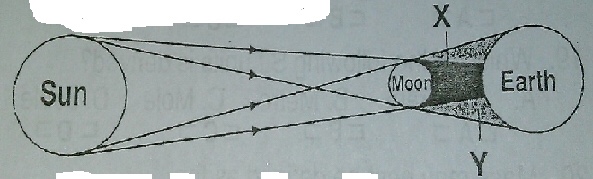
- Illustrates an eclipse of the moon
- Portion X is called penumbra
- Illustrates an eclipse of the sun
- Portion Y is called Umbra
28. The type of soil which feels sticky at the fingers when wet is
- clay
- silt
- loam
- sand
29. Highly decomposed plant and animal matter is known as
- compost
- humus
- green manure
- loam
30. Which of the following crops is not correctly matched to its group?
- Yam —> tuber crop
- Ginger —> root crop
- Maize –> cereal crop
- Cocoa —> beverage crop
31. Which of the following crop groups does sorghum belong to?
- Cereals
- Legumes
- Root tubers
- Vegetables
32. Which of the following crops is a fruit vegetable?
- Cabbage
- Carrot
- Orange
- Tomato
33. Avenue trees are trees that are grown
- for their beautiful flowers
- to provide shade for drivers
- along the sides of roads
- for their fruits
34. Which of the following crops produces edible fruits?
- Stylosanthes
- Banana
- Cauliflower
- Cassava
35. Which of the following methods of plant propagation is sexual?
- Budding
- Grafting
- Layering
- Seeding
36. Weeds are plants that
- grow where they are not wanted
- cause diseases among crops
- add nitrates to the soil
- control soil nematodes
37. Pesticides used for controlling nematodes on the field are called
- insecticides
- acaricides
- rodenticides
- nematicides
38. Marigold is grown on the field to control
- fungi
- bacteria
- nematodes
- insects
39. The most destructive crop pests are
- ruminants
- insects
- rodents
- birds
40. What group name is given to agro-chemicals used in controlling armyworms on crops?
- Rodenticides
- Fungicides
- Herbicides
- Insecticides

 Educational News Ghana
Michaelagbenorku25@gamil.com
LikeLike