
Digestion
In order for the food that we have eaten to be useful to our body it needs to be broken down into small molecules which can then easily be absorbed. Large food molecules such as starch, protein and fat are insoluble and cannot dissolve, thus they are unable to pass through the gut wall. *On the other hand small food molecules such as glucose, amino acids, fatty acids and glycerol are soluble and can dissolve, thus they are able to pass through the gut wall.
The breakdown of large food molecules into small food molecules is called digestion*. Once the food has been digested it dissolves and can then be absorbed through the gut wall into the blood stream. The definition of digestion is as follows:
Digestion is the break down of large, insoluble food molecules into small, soluble food molecules so that they can be absorbed into the blood stream.

The digestive system also known as the gut is essentially a long tube about 9 metres long. It starts at the mouth and ends at the anus. There are many different parts to the digestive system but each part has its specific function.
Oral Cavity (Mouth)
Teeth
Food enters the mouth and digestion begins with the teeth breaking down the food into smaller pieces. This serves 2 purposes:
✅Makes the food easier to swallow
✅Gives food a large surface area for enzymes to work on
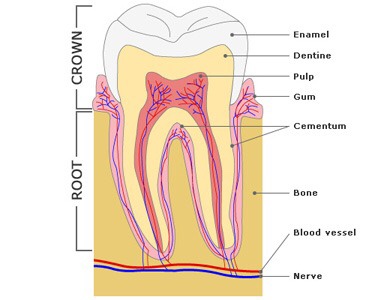
A full set of adult teeth consists of 32 teeth. But not all teeth are the same and are shaped and designed for different jobs. There are four different types of human teeth:
✅Incisors are used for cutting and biting.
✅Canines are pointed and used for piercing and tearing.
✅Pre-molars are used for grinding and crushing.
✅Molars are like pre-molars and used for crushing and chewing.
In a full set of adult teeth there are *8 incisors, 4 canines, 8 pre-molars and 12 molars* which makes 32 in total.
*Salivary glands*
The salivary glands secrete saliva which mixes with the chewed food. Saliva has two functions:
✅Saliva contains the enzyme amylase which is a carbohydrase and breaks down starch into sugar.
✅Saliva also contains mucus which lubricates the food and helps it pass down the oesophagus.

*Pharynx & Oesophagus*
Swallowing
Swallowing is a reflex reaction and happens without us thinking about it. Before swallowing the tongue rolls the food into a soft ball and pushes it to the back of the mouth. The food pushes the soft palate upwards which blocks the upper pharynx and stops food going into the nasal cavity. Voluntary muscles in the face, neck and tongue push the food through the pharynx. As the food is swallowed it passes over the epiglottis which covers the opening of the respiratory system and prevents food entering it. Food passes the epiglottis and into the oesophagus which connects the pharynx to the stomach.
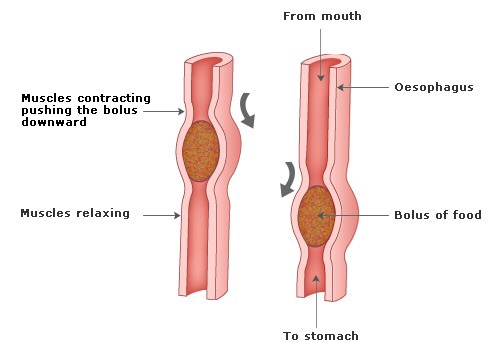
Now the food enters the oesophagus and is called a bolus. The oesophagus has circular muscles in the wall. These muscles contract behind the bolus to push it along and the muscles in front of the food relax. This way food passes along the oesophagus to the stomach. This movement is known as *peristalsis*.
*Stomach*
The bolus enters the stomach. The stomach cells makes gastric juices which mix with the food.
The gastric juices contain a *protease enzyme* called *pepsin* which breaks down proteins into amino acids.
The juices also contain hydrochloric acid, this is because pepsin works best in an acidic environment of pH 2.
The acid in the juices also kills any germs.
The muscular walls of the stomach churn the food and mix it well with the secretions. After 2-3 hours of churning the food is a thick liquid called *chyme*.
*Small Intestine*
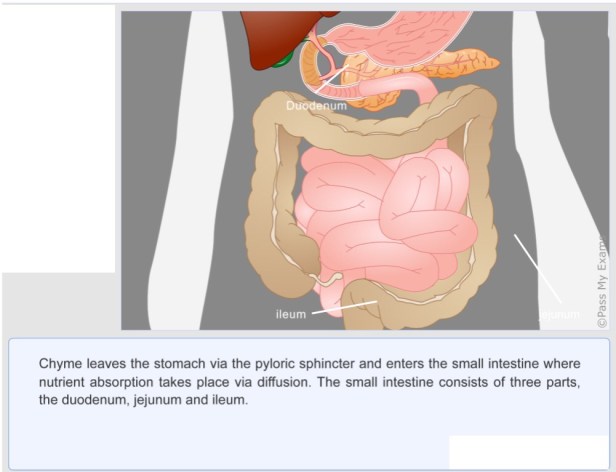
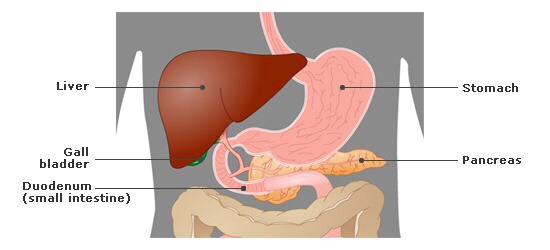
The small intestine is about 6 metres long. Chyme leaves the stomach via the *pyloric sphincter* and enters the small intestine. The small intestine consists of three parts, *the duodenum, jejunum and ileum*.
In the small intestine 3 important juices are added to the food.
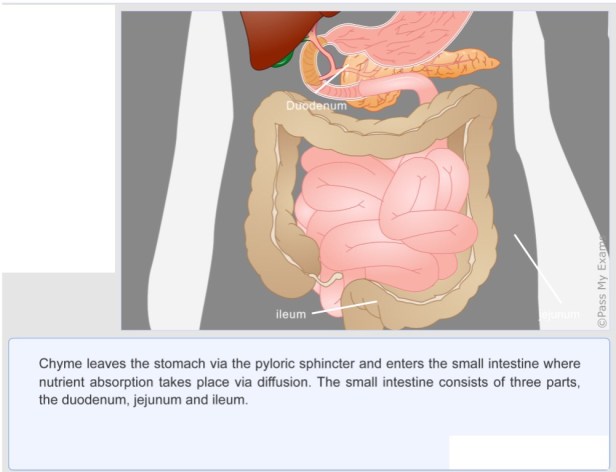
*BILE*: The liver produces bile which is stored in the gall bladder and enters the small intestine via the bile duct. Bile has 2 important functions:
✅Bile is alkaline and neutralises the acid which was added to the food in the stomach. This provides the best pH for the enzymes in the small intestine to work at.
✅Bile emulsifies fats, that is it breaks large molecules of fat into smaller droplets which increases the surface area of fats for the enzyme lipase to work on.
*PANCREATIC JUICE*: The pancreas produce pancreatic juices which contain carbohydrases, proteases and lipases. These enzymes empty into the duodenum to further continue digesting the food.
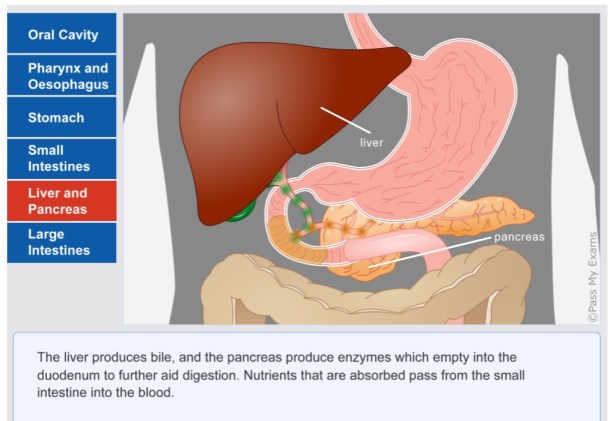
*INTESTINAL JUICE*: The glands in the wall of the small intestine produce intestinal juice. This also contains carbohydrases, proteases and lipases. These enzymes complete the digestion of the food.
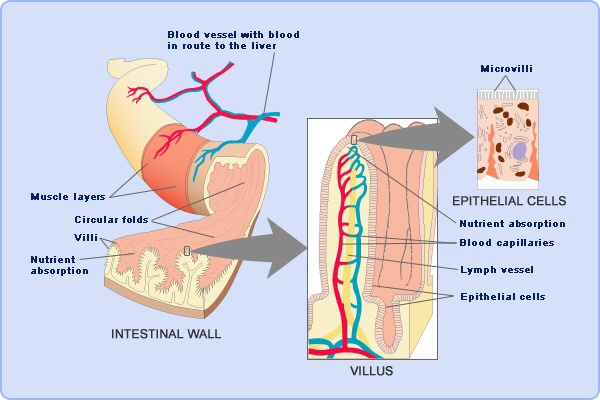
In addition to digestion the small intestine has another important job and this is *ABSORPTION*. The small intestine is ideal for absorption because it has:
✅A thin lining
✅Plentiful blood supply
✅Very large surface area
The surface area of the small intestine is around 9 square metres! This is possible because the small intestine is very long (around 6 metres) and it is lined with tiny finger like projections called *villi*. Each villus in turn is covered with even smaller *microvilli*. The villi have very thin walls and a good blood supply which means that the digested food can be easily absorbed from the gut into the blood. There are millions of villi which provide a massive surface area to maximise the rate of absorption.
Large Intestine
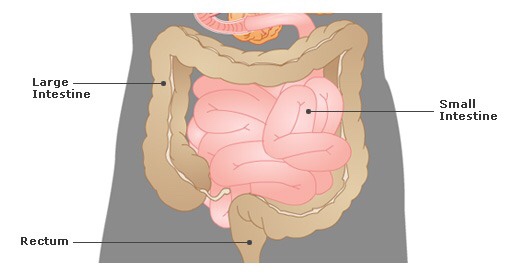
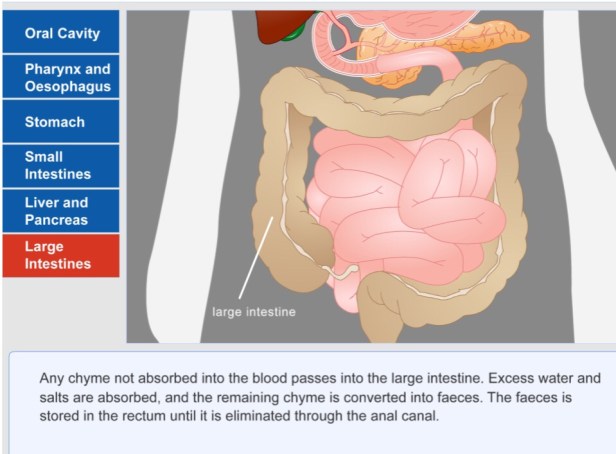
Any indigestible or non absorbed chyme passes into the large intestine. Excess water and salts are absorbed and the remaining chyme is converted into *faeces*. The faeces is stored in the *rectum* until it is excreted through the *anal canal*.
Enzymes
As we know enzymes are important molecules, they are particularly important in digestion as they help break down large, insoluble food molecules into small, soluble molecules which can be easily absorbed. Enzymes work best at their optimum pH. So for example if the stomach does not produce enough HCl, the enzyme, pepsin, will not work properly, (remember the optimum pH for pepsin is 2).
There are 3 main types of enzymes in our gut:
Protease, Carbohydrase, and Lipase.
Protease
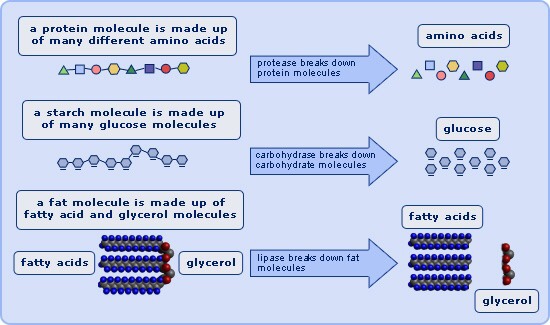
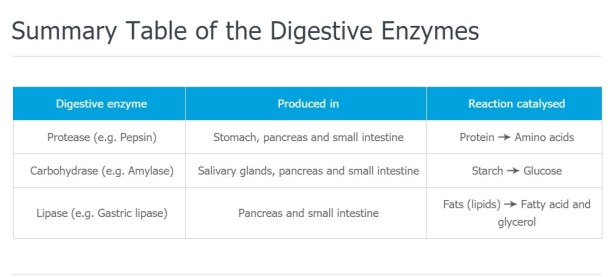
Protease enzymes are secreted by the stomach, pancreas and small intestine and their job is to digest proteins. An example of a *protease is pepsin* which is secreted in the stomach. Proteins are long chains of amino acids, and protease enzymes break them into *peptides (smaller chains of amino acids molecules)* and eventually into individual amino acids, which are small and easily absorbed in the small intestine. The word equation for the protease reaction is:
proteins ➡️ protease(enzymes) ➡️ amino acids
Carbohydrase
Carbohydrase enzymes are secreted by the mouth, pancreas and small intestine. The carbohydrase enzyme, *amylase* is secreted by the mouth and found in saliva. It starts to work as soon as we begin to chew our food. Amylase digests long, complex starch (polysaccharide) molecules, into smaller, simpler maltose (disaccharide) molecules. As maltose is a disaccharide it still needs further digestion before it can be absorbed. The enzyme *maltase* breaks it down into glucose. The word equation is:
*starch➡️amylase(enzyme)➡️maltose➡️maltase(enzyme)➡️glucose*
Other dietary sugars such as sucrose and lactose (both disaccharides) are broken down further by different carbohydrase enzymes. The word equations are:
*sucrose➡️sucrase(enzyme)➡️glucose + fructose*
*lactose➡️lactase(enzyme)➡️glucose + galactose
Lipase
Lipase is secreted by the pancreas and the walls of the small intestine. It digests complex fat (or lipid) molecules into simple, soluble fatty acid and glycerol molecules. The word equation for this reaction is:
*Lipids➡️lipase(enzyme)➡️fatty acids + glycerol*
*NOTE*: It’s important you recall the main digestive enzymes, the food types they break down and where they are produced.
 Educational News Ghana